History
View all in History
Odiani Clan: A Yoruba Enclave in the Heart of Anioma
By Adim Abuah on February 9, 2026
𝐈𝐧𝐭𝐫𝐨𝐝𝐮𝐜𝐭𝐢𝐨𝐧
The history of Anioma communities is inseparable from the patterns of migration, cultural
intersections and shifting identities that have shaped western Nigeria. Among the lesser
known but historically rich communities within this landscape is the Odiani, or Olukumi
clan, located in Aniocha North of Delta State. Odiani clan, also known as the Olukumi people
represent a case of cultural synthesis rooted in a Yoruboid past, extended through Edo contact
and ultimately settled within an Igbo-speaking region. Their language, traditions and oral memory
preserve a distinctive identity that stands apart from their Anioma neighbors, yet remains
embedded in the shared historical experience of the region.
This article examines the formation of the Odiani clan from a historiographical perspective,
placing it within the wider framework of Yoruba-Benin-Anioma interaction. It draws on oral
histories, linguistic research and local cultural accounts to reconstruct the evolution of the
Odiani people. The focus is not solely on tracing their origins, but also on understanding
the layered dimensions of their kingship, religious life, language, inter-communal ties and
cultural memory. Through this lens, the Odiani are presented not as cultural anomalies,
but as a living example of historical fusion within the Anioma region
𝐇𝐢𝐬𝐭𝐨𝐫𝐢𝐜𝐚𝐥 𝐎𝐫𝐢𝐠𝐢𝐧𝐬 𝐚𝐧𝐝 𝐌𝐢𝐠𝐫𝐚𝐭𝐢𝐨𝐧
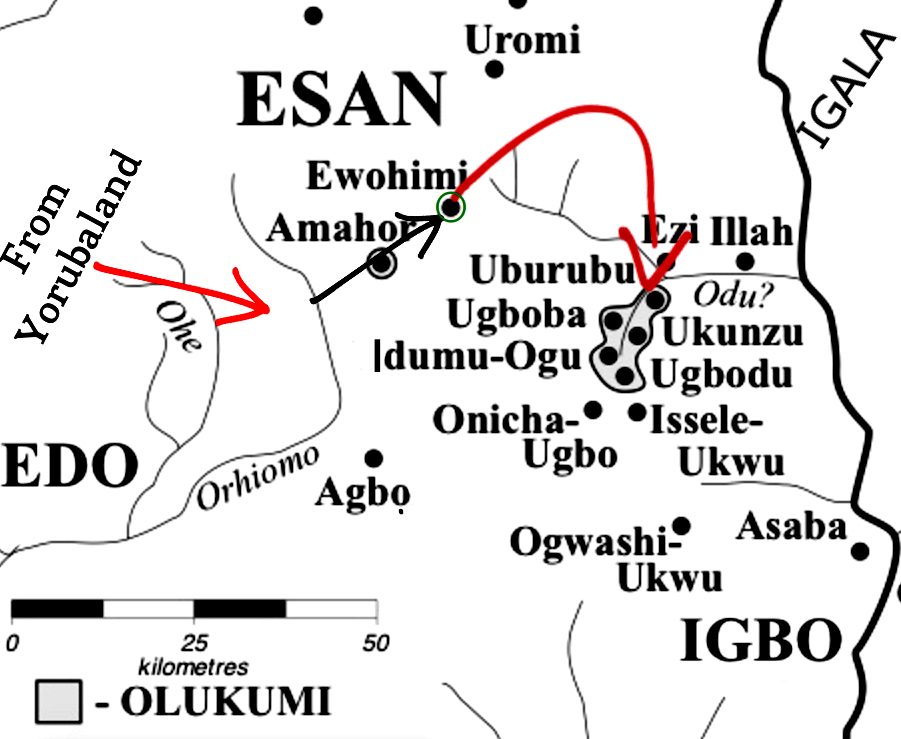
The communities of the Odiani clan trace their ancestry to Yoruba-speaking migrants from
Ife, Owo and Akure, who moved eastward over several centuries. Oral traditions record
that the earliest settlement, Ugbodu, was founded between the twelfth and fifteenth
centuries by a group led by Kokoroko (also called Adetola), a figure of Akure origin.
According to oral custodians in Ugbodu, these early migrants passed through Benin during
the Ogiso period, encountered internal palace conflict and moved on to Esan territory,
specifically Ewohimi. Conflict there again prompted their eastward movement, ending with
the establishment of Ugbodu. This settlement became the central point from which other
Odiani communities emerged.
Subsequent waves of migration introduced new figures and groups into the region. A
group from Owo, remembered as Ologun Uja, arrived in the seventeenth century and
assisted Ugbodu during conflicts with Esan neighbors. Their contributions led to the
institution of a distinct warrior chieftaincy in the Ugbodu sociopolitical structure.
Meanwhile, another early settlement, Ukwu Nzu (historically known as Eko Ẹfun, or “chalk
camp”), was founded by a leader named Ogbe or Ugbe, said to have originated from Ile-Ife.
By the eighteenth and nineteenth centuries, the Odiani clan had expanded into a network
of seven settlements: Ugbodu, Ukwu Nzu, Ubulubu, Idumu Ogo, Ugboba, Ogodor and
Anioma village. Ubulubu and Idumu Ogo emerged as extensions of Ugbodu and Ukwu Nzu.
Ugboba and Ogodor were later additions, reportedly influenced by Edo migrants, while
Anioma was established by migrants from Ubulubu. These communities occupy a small but
historically significant belt in western Anioma, near the western bank of the Niger.
𝐄𝐚𝐫𝐥𝐲 𝐋𝐞𝐚𝐝𝐞𝐫𝐬 𝐚𝐧𝐝 𝐅𝐨𝐮𝐧𝐝𝐞𝐫𝐬
The genealogies of the Odiani towns are maintained through lineage memory and oral
performance. Kokoroko, the Akure-origin founder of Ugbodu, and Oligbo, another pioneer
associated with the Isile group, are foundational names in the clan’s narrative. The Isile
people, identified as early settlers or strangers, joined the Ugbodu founders and are
sometimes credited with introducing the term Olukumi. Ugbodu retains a quarter named
Ologoza, commemorating the Owo warriors who defended the town in the late seventeenth
century.
Other towns trace their leadership back to identifiable figures as well. Ugbe of Ife is
credited with founding Ukwu Nzu. Ubulubu, founded around 1800 by migrants from
Ugbodu and Ukwu Nzu, developed a different system of governance led by a council of
elders (Okpalabisi) rather than a hereditary monarchy. Ugboba and Ogodor are understood
to have Edo heritage, while Anioma remained politically tied to Ubulubu.
Across the Odiani towns, leadership traditions reflect a convergence of Yoruba, Edo and
Igbo influences. Ugbodu’s monarch bears the title Ọlọza, and earlier holders of the title
carried Yoruba names. Over time, Edo and Igbo names began to appear in the chieftaincy,
reflecting both external influence and internal adaptation. Ukwu Nzu adopted the title Obi,
and its ruler, Ogoh I, ascended the throne in the 1970s. All Odiani communities maintain
advisory councils composed of elders selected from senior lineages.
Religious authority is also embedded in lineage structures. In Ugbodu, the primary
ancestral and land deities are Alẹ-Ugbodu and Alẹ-Ighare. In Ukwu Nzu, royal
enthronement is tied to the Ihongbuda shrine, with specific ritual items passed from one
ruling house to the next. These practices illustrate a religious system shaped by multiple
historical layers, with Yoruba, Edo and Igbo elements coexisting
𝐓𝐡𝐞 𝐎𝐥𝐮𝐤𝐮𝐦𝐢 𝐋𝐚𝐧𝐠𝐮𝐚𝐠𝐞: 𝐄𝐯𝐨𝐥𝐮𝐭𝐢𝐨𝐧 𝐚𝐧𝐝 𝐒𝐭𝐚𝐭𝐮𝐬
Olukumi is a Yoruboid language and functions as the primary marker of Odiani identity. The
name itself, Olukumi, means “my friend” or “my confidant” in Yoruba, underscoring its
origin in Yoruba migration. Linguistic studies place Olukumi within the Niger-Congo family,
closely related to Yoruba, and note similarities with languages such as Itsekiri.
Today, Olukumi survives in three of the seven Odiani towns: Ugbodu, Ukwu Nzu and
Ubulubu. The remaining four have adopted Enuani Igbo as their dominant language, with
only vestigial traces of Olukumi. Even within the core-speaking towns, Olukumi shows
signs of decline. In Ugbodu, it is still spoken fluently by elders and used in community
rituals. In Ukwu Nzu and Ubulubu, Olukumi is heavily influenced by Igbo vocabulary and
syntax.
Olukumi is not taught in schools and is not widely written, but efforts have been made to
preserve it. The Ugbodu traditional council has supported the development of an Olukumi
English dictionary and an Olukumi translation of the New Testament. Some churches
conduct services and prayers in Olukumi, and youth programs have been introduced to
encourage oral fluency. Despite these efforts, the language remains endangered,
particularly in the face of dominant Igbo usage in surrounding communities.
The bilingualism of the Odiani people once carried symbolic prestige. Speaking both
Olukumi and Igbo indicated cultural rootedness and regional adaptability. Today, that
prestige is being redefined through conscious preservation, identity discourse and
linguistic revival initiatives
𝐂𝐮𝐥𝐭𝐮𝐫𝐞, 𝐅𝐞𝐬𝐭𝐢𝐯𝐚𝐥𝐬 𝐚𝐧𝐝 𝐁𝐞𝐥𝐢𝐞𝐟𝐬
Cultural life in the Odiani communities follows a blended path, shaped by Yoruba
foundations, Benin contact and Igbo regional norms. Festivities such as the New Yam
Festival are celebrated in all towns, with accompanying rituals like Ifejioku (yam sacrifice)
reflecting regional practice. Ancestral veneration, land deity observances and seasonal
rites remain integral to community life.
Funeral practices provide a key example of cultural variation. In some Odiani communities,
burial rites extend over seven days, more in line with Edo or Esan patterns, as opposed to
the four-day structure common in most Igbo communities. Marriage and title-taking
customs, on the other hand, follow the Anioma pattern, with ceremonies conducted in Igbo
and family negotiations rooted in Igbo lineage systems.
Christianity has become the dominant religion in the region, particularly Roman
Catholicism and Anglicanism. Churches have played an active role in cultural preservation,
introducing Olukumi hymnals, incorporating Olukumi phrases in sermons and encouraging
youth participation in cultural activities.
Although no distinct Olukumi masquerade systems have survived in full, symbolic
remnants exist in seasonal festivals, music and oral performance. Traditional dress,
especially white and colorful wrappers known as akwaocha, is shared with the wider
Anioma region
𝐆𝐨𝐯𝐞𝐫𝐧𝐚𝐧𝐜𝐞 𝐚𝐧𝐝 𝐀𝐝𝐦𝐢𝐧𝐢𝐬𝐭𝐫𝐚𝐭𝐢𝐨𝐧
Historically, each Odiani town operated as an autonomous polity. The monarch and senior
elders managed political and ritual affairs. Ugbodu’s Oloza, Ukwu Nzu’s Obi and Ubulubu’s
elder council represent the three core governing systems of the clan. Hereditary
chieftaincy remains strong in some towns, while others use seniority-based systems
adapted from Igbo political logic.
Under British colonial rule, the Odiani villages were grouped into a single Native Authority
centered in Ukwu Nzu. This realignment followed the 1904 Ekumeku conflict, in which
colonial administrators shifted the regional seat of governance from Ugbodu to Ukwu Nzu.
Despite this change, Ugbodu remains culturally regarded as the senior town. After
independence, all Odiani towns were incorporated into the Aniocha North Local
Government Area.
Today, governance in Odiani communities reflects the broader Anioma structure.
Monarchs operate alongside elected officials, elders’ councils continue to play advisory
roles and traditional rites coexist with modern administration. The Odiani retain internal
cohesion through festivals, family alliances and linguistic ties, even as they participate
fully in the wider political life of Anioma.
𝐎𝐥𝐮𝐤𝐮𝐦𝐢 𝐚𝐧𝐝 𝐈𝐠𝐛𝐨-𝐒𝐩𝐞𝐚𝐤𝐢𝐧𝐠 𝐓𝐨𝐰𝐧𝐬: 𝐀 𝐂𝐨𝐦𝐩𝐚𝐫𝐢𝐬𝐨𝐧
The division between Olukumi-speaking and Igbo-speaking Odiani towns illustrates a
broader historical dynamic. Ugbodu, Ukwu Nzu and Ubulubu preserve the Olukumi
language and certain Yoruba cultural features. In contrast, Ugboba, Idumu Ogo, Ogodor
and Anioma village have adopted Enuani Igbo entirely. These towns were influenced by
later migrations and cultural assimilation from neighboring Igbo and Esan populations.
Despite linguistic differences, cultural continuity remains. Dress, festivals, age-grade
systems and community structures are shared across the Odiani towns. Ritual and
ceremonial differences exist, but they are integrated into the overall Anioma cultural
rhythm. Some practices, such as extended funeral durations or ancestral titles, preserve
the memory of Odiani’s distinct past, even within the larger Igbo-speaking context
𝐎𝐫𝐚𝐥 𝐓𝐫𝐚𝐝𝐢𝐭𝐢𝐨𝐧𝐬 𝐚𝐧𝐝 𝐌𝐞𝐦𝐨𝐫𝐲
Odiani identity is preserved through oral history, family memory and community ritual.
Elders recount the migration from Yorubaland through Benin and Esan, and the eventual
settlement of Ugbodu. These accounts are reinforced by cultural performances and public
ceremonies. Books such as George Nkemnacho’s “Olukumi Kingdom” and articles in local
newspapers have documented the history of the Odiani people, bringing scholarly and
public attention to their heritage.
Today, community memory is also curated through digital media. Facebook pages, cultural
blogs and local forums share Odiani stories, songs and language lessons. Community
events emphasize traditional knowledge, and some families maintain oral genealogies
tracing their lineages to the original Yoruba migrants.
This oral tradition is not fixed but dynamic. It accommodates changes in language, religion
and governance while maintaining the core narrative of Odiani as a Yoruboid-speaking
people who adapted to a changing regional environment. The Odiani case affirms that
cultural identity is not singular, but layered and continuously negotiated
𝐂𝐨𝐧𝐜𝐥𝐮𝐬𝐢𝐨𝐧
The history of the Odiani clan offers a window into the processes of migration, contact and
adaptation that define Anioma. Emerging from Yorubaland, shaped by Benin encounter and
embedded in an Igbo-speaking region, the Odiani illustrate how historical identities are
formed and transformed across generations.
They are not simply Yoruba exiles nor Igbo converts, but a community that carries
elements of both, reshaped by place and time. Olukumi, their language, remains a fragile
but vital marker of this history. Their governance structures, religious practices and
festivals reflect a shared heritage that is at once distinctive and interconnected with the
broader Anioma experience.
Understanding the Odiani in this way enhances our appreciation of Anioma as a frontier
region where identity is not fixed, but continuously constructed through encounter,
negotiation and cultural memory.
𝐑𝐞𝐟𝐞𝐫𝐞𝐧𝐜𝐞𝐬
Aluko, B. (2010, 2015, 2022). Olukumi people of Delta State and their Yoruba origins.
Nigerian Tribune (various reprints and online editions).
Bamgbose, A. A. (1966). A grammar of Yoruba. Cambridge University Press.
(Referenced for comparative Yoruboid linguistic classification relevant to Olukumi.)
Beier, H. U. (1953). Notes on the Olukumi people of Western Nigeria.
(Unpublished field notes and linguistic observations, cited in later ethnolinguistic
studies.)
Esogbue, E. (2016). Anioma history and ethnographic notes.
(Online cultural essays and regional history blog posts.)
Nkemnacho, G. (2024). Olukumi Kingdom: History, language and identity of the Odiani
people.
Self-published monograph, Ugbodu.
Nwoye, G. (2008). Language contact and shift in border communities of Delta State.
Journal of West African Linguistics, 35(2), 45–68.
Ohadike, D. C. (1994). Anioma: A social history of the Western Igbo people. Ohio
University Press.
Talbot, P. A. (1926). The peoples of Southern Nigeria.
Oxford University Press.
(Referenced for early colonial observations of Anioma and neighboring Edo–Igbo frontier
zones.)
Ugbodu Traditional Council. (2022). Olukumi–English Dictionary Project and New
Testament Translation.
Community publication and launch materials.
Ukwu-Nzu Palace Records. (1974). Coronation and lineage records of the Obi of Ukwu
Nzu.
Unpublished palace archives.
Oral interviews and community accounts from:
• Ugbodu
• Ukwu-Nzu
• Ubulubu
• Idumu-Ogo
• Ugboba
• Ogodor
The history of Anioma communities is inseparable from the patterns of migration, cultural
intersections and shifting identities that have shaped western Nigeria. Among the lesser
known but historically rich communities within this landscape is the Odiani, or Olukumi
clan, located in Aniocha North of Delta State. Odiani clan, also known as the Olukumi people
represent a case of cultural synthesis rooted in a Yoruboid past, extended through Edo contact
and ultimately settled within an Igbo-speaking region. Their language, traditions and oral memory
preserve a distinctive identity that stands apart from their Anioma neighbors, yet remains
embedded in the shared historical experience of the region.
This article examines the formation of the Odiani clan from a historiographical perspective,
placing it within the wider framework of Yoruba-Benin-Anioma interaction. It draws on oral
histories, linguistic research and local cultural accounts to reconstruct the evolution of the
Odiani people. The focus is not solely on tracing their origins, but also on understanding
the layered dimensions of their kingship, religious life, language, inter-communal ties and
cultural memory. Through this lens, the Odiani are presented not as cultural anomalies,
but as a living example of historical fusion within the Anioma region
𝐇𝐢𝐬𝐭𝐨𝐫𝐢𝐜𝐚𝐥 𝐎𝐫𝐢𝐠𝐢𝐧𝐬 𝐚𝐧𝐝 𝐌𝐢𝐠𝐫𝐚𝐭𝐢𝐨𝐧
The communities of the Odiani clan trace their ancestry to Yoruba-speaking migrants from
Ife, Owo and Akure, who moved eastward over several centuries. Oral traditions record
that the earliest settlement, Ugbodu, was founded between the twelfth and fifteenth
centuries by a group led by Kokoroko (also called Adetola), a figure of Akure origin.
According to oral custodians in Ugbodu, these early migrants passed through Benin during
the Ogiso period, encountered internal palace conflict and moved on to Esan territory,
specifically Ewohimi. Conflict there again prompted their eastward movement, ending with
the establishment of Ugbodu. This settlement became the central point from which other
Odiani communities emerged.
Subsequent waves of migration introduced new figures and groups into the region. A
group from Owo, remembered as Ologun Uja, arrived in the seventeenth century and
assisted Ugbodu during conflicts with Esan neighbors. Their contributions led to the
institution of a distinct warrior chieftaincy in the Ugbodu sociopolitical structure.
Meanwhile, another early settlement, Ukwu Nzu (historically known as Eko Ẹfun, or “chalk
camp”), was founded by a leader named Ogbe or Ugbe, said to have originated from Ile-Ife.
By the eighteenth and nineteenth centuries, the Odiani clan had expanded into a network
of seven settlements: Ugbodu, Ukwu Nzu, Ubulubu, Idumu Ogo, Ugboba, Ogodor and
Anioma village. Ubulubu and Idumu Ogo emerged as extensions of Ugbodu and Ukwu Nzu.
Ugboba and Ogodor were later additions, reportedly influenced by Edo migrants, while
Anioma was established by migrants from Ubulubu. These communities occupy a small but
historically significant belt in western Anioma, near the western bank of the Niger.
𝐄𝐚𝐫𝐥𝐲 𝐋𝐞𝐚𝐝𝐞𝐫𝐬 𝐚𝐧𝐝 𝐅𝐨𝐮𝐧𝐝𝐞𝐫𝐬
The genealogies of the Odiani towns are maintained through lineage memory and oral
performance. Kokoroko, the Akure-origin founder of Ugbodu, and Oligbo, another pioneer
associated with the Isile group, are foundational names in the clan’s narrative. The Isile
people, identified as early settlers or strangers, joined the Ugbodu founders and are
sometimes credited with introducing the term Olukumi. Ugbodu retains a quarter named
Ologoza, commemorating the Owo warriors who defended the town in the late seventeenth
century.
Other towns trace their leadership back to identifiable figures as well. Ugbe of Ife is
credited with founding Ukwu Nzu. Ubulubu, founded around 1800 by migrants from
Ugbodu and Ukwu Nzu, developed a different system of governance led by a council of
elders (Okpalabisi) rather than a hereditary monarchy. Ugboba and Ogodor are understood
to have Edo heritage, while Anioma remained politically tied to Ubulubu.
Across the Odiani towns, leadership traditions reflect a convergence of Yoruba, Edo and
Igbo influences. Ugbodu’s monarch bears the title Ọlọza, and earlier holders of the title
carried Yoruba names. Over time, Edo and Igbo names began to appear in the chieftaincy,
reflecting both external influence and internal adaptation. Ukwu Nzu adopted the title Obi,
and its ruler, Ogoh I, ascended the throne in the 1970s. All Odiani communities maintain
advisory councils composed of elders selected from senior lineages.
Religious authority is also embedded in lineage structures. In Ugbodu, the primary
ancestral and land deities are Alẹ-Ugbodu and Alẹ-Ighare. In Ukwu Nzu, royal
enthronement is tied to the Ihongbuda shrine, with specific ritual items passed from one
ruling house to the next. These practices illustrate a religious system shaped by multiple
historical layers, with Yoruba, Edo and Igbo elements coexisting
𝐓𝐡𝐞 𝐎𝐥𝐮𝐤𝐮𝐦𝐢 𝐋𝐚𝐧𝐠𝐮𝐚𝐠𝐞: 𝐄𝐯𝐨𝐥𝐮𝐭𝐢𝐨𝐧 𝐚𝐧𝐝 𝐒𝐭𝐚𝐭𝐮𝐬
Olukumi is a Yoruboid language and functions as the primary marker of Odiani identity. The
name itself, Olukumi, means “my friend” or “my confidant” in Yoruba, underscoring its
origin in Yoruba migration. Linguistic studies place Olukumi within the Niger-Congo family,
closely related to Yoruba, and note similarities with languages such as Itsekiri.
Today, Olukumi survives in three of the seven Odiani towns: Ugbodu, Ukwu Nzu and
Ubulubu. The remaining four have adopted Enuani Igbo as their dominant language, with
only vestigial traces of Olukumi. Even within the core-speaking towns, Olukumi shows
signs of decline. In Ugbodu, it is still spoken fluently by elders and used in community
rituals. In Ukwu Nzu and Ubulubu, Olukumi is heavily influenced by Igbo vocabulary and
syntax.
Olukumi is not taught in schools and is not widely written, but efforts have been made to
preserve it. The Ugbodu traditional council has supported the development of an Olukumi
English dictionary and an Olukumi translation of the New Testament. Some churches
conduct services and prayers in Olukumi, and youth programs have been introduced to
encourage oral fluency. Despite these efforts, the language remains endangered,
particularly in the face of dominant Igbo usage in surrounding communities.
The bilingualism of the Odiani people once carried symbolic prestige. Speaking both
Olukumi and Igbo indicated cultural rootedness and regional adaptability. Today, that
prestige is being redefined through conscious preservation, identity discourse and
linguistic revival initiatives
𝐂𝐮𝐥𝐭𝐮𝐫𝐞, 𝐅𝐞𝐬𝐭𝐢𝐯𝐚𝐥𝐬 𝐚𝐧𝐝 𝐁𝐞𝐥𝐢𝐞𝐟𝐬
Cultural life in the Odiani communities follows a blended path, shaped by Yoruba
foundations, Benin contact and Igbo regional norms. Festivities such as the New Yam
Festival are celebrated in all towns, with accompanying rituals like Ifejioku (yam sacrifice)
reflecting regional practice. Ancestral veneration, land deity observances and seasonal
rites remain integral to community life.
Funeral practices provide a key example of cultural variation. In some Odiani communities,
burial rites extend over seven days, more in line with Edo or Esan patterns, as opposed to
the four-day structure common in most Igbo communities. Marriage and title-taking
customs, on the other hand, follow the Anioma pattern, with ceremonies conducted in Igbo
and family negotiations rooted in Igbo lineage systems.
Christianity has become the dominant religion in the region, particularly Roman
Catholicism and Anglicanism. Churches have played an active role in cultural preservation,
introducing Olukumi hymnals, incorporating Olukumi phrases in sermons and encouraging
youth participation in cultural activities.
Although no distinct Olukumi masquerade systems have survived in full, symbolic
remnants exist in seasonal festivals, music and oral performance. Traditional dress,
especially white and colorful wrappers known as akwaocha, is shared with the wider
Anioma region
𝐆𝐨𝐯𝐞𝐫𝐧𝐚𝐧𝐜𝐞 𝐚𝐧𝐝 𝐀𝐝𝐦𝐢𝐧𝐢𝐬𝐭𝐫𝐚𝐭𝐢𝐨𝐧
Historically, each Odiani town operated as an autonomous polity. The monarch and senior
elders managed political and ritual affairs. Ugbodu’s Oloza, Ukwu Nzu’s Obi and Ubulubu’s
elder council represent the three core governing systems of the clan. Hereditary
chieftaincy remains strong in some towns, while others use seniority-based systems
adapted from Igbo political logic.
Under British colonial rule, the Odiani villages were grouped into a single Native Authority
centered in Ukwu Nzu. This realignment followed the 1904 Ekumeku conflict, in which
colonial administrators shifted the regional seat of governance from Ugbodu to Ukwu Nzu.
Despite this change, Ugbodu remains culturally regarded as the senior town. After
independence, all Odiani towns were incorporated into the Aniocha North Local
Government Area.
Today, governance in Odiani communities reflects the broader Anioma structure.
Monarchs operate alongside elected officials, elders’ councils continue to play advisory
roles and traditional rites coexist with modern administration. The Odiani retain internal
cohesion through festivals, family alliances and linguistic ties, even as they participate
fully in the wider political life of Anioma.
𝐎𝐥𝐮𝐤𝐮𝐦𝐢 𝐚𝐧𝐝 𝐈𝐠𝐛𝐨-𝐒𝐩𝐞𝐚𝐤𝐢𝐧𝐠 𝐓𝐨𝐰𝐧𝐬: 𝐀 𝐂𝐨𝐦𝐩𝐚𝐫𝐢𝐬𝐨𝐧
The division between Olukumi-speaking and Igbo-speaking Odiani towns illustrates a
broader historical dynamic. Ugbodu, Ukwu Nzu and Ubulubu preserve the Olukumi
language and certain Yoruba cultural features. In contrast, Ugboba, Idumu Ogo, Ogodor
and Anioma village have adopted Enuani Igbo entirely. These towns were influenced by
later migrations and cultural assimilation from neighboring Igbo and Esan populations.
Despite linguistic differences, cultural continuity remains. Dress, festivals, age-grade
systems and community structures are shared across the Odiani towns. Ritual and
ceremonial differences exist, but they are integrated into the overall Anioma cultural
rhythm. Some practices, such as extended funeral durations or ancestral titles, preserve
the memory of Odiani’s distinct past, even within the larger Igbo-speaking context
𝐎𝐫𝐚𝐥 𝐓𝐫𝐚𝐝𝐢𝐭𝐢𝐨𝐧𝐬 𝐚𝐧𝐝 𝐌𝐞𝐦𝐨𝐫𝐲
Odiani identity is preserved through oral history, family memory and community ritual.
Elders recount the migration from Yorubaland through Benin and Esan, and the eventual
settlement of Ugbodu. These accounts are reinforced by cultural performances and public
ceremonies. Books such as George Nkemnacho’s “Olukumi Kingdom” and articles in local
newspapers have documented the history of the Odiani people, bringing scholarly and
public attention to their heritage.
Today, community memory is also curated through digital media. Facebook pages, cultural
blogs and local forums share Odiani stories, songs and language lessons. Community
events emphasize traditional knowledge, and some families maintain oral genealogies
tracing their lineages to the original Yoruba migrants.
This oral tradition is not fixed but dynamic. It accommodates changes in language, religion
and governance while maintaining the core narrative of Odiani as a Yoruboid-speaking
people who adapted to a changing regional environment. The Odiani case affirms that
cultural identity is not singular, but layered and continuously negotiated
𝐂𝐨𝐧𝐜𝐥𝐮𝐬𝐢𝐨𝐧
The history of the Odiani clan offers a window into the processes of migration, contact and
adaptation that define Anioma. Emerging from Yorubaland, shaped by Benin encounter and
embedded in an Igbo-speaking region, the Odiani illustrate how historical identities are
formed and transformed across generations.
They are not simply Yoruba exiles nor Igbo converts, but a community that carries
elements of both, reshaped by place and time. Olukumi, their language, remains a fragile
but vital marker of this history. Their governance structures, religious practices and
festivals reflect a shared heritage that is at once distinctive and interconnected with the
broader Anioma experience.
Understanding the Odiani in this way enhances our appreciation of Anioma as a frontier
region where identity is not fixed, but continuously constructed through encounter,
negotiation and cultural memory.
𝐑𝐞𝐟𝐞𝐫𝐞𝐧𝐜𝐞𝐬
Aluko, B. (2010, 2015, 2022). Olukumi people of Delta State and their Yoruba origins.
Nigerian Tribune (various reprints and online editions).
Bamgbose, A. A. (1966). A grammar of Yoruba. Cambridge University Press.
(Referenced for comparative Yoruboid linguistic classification relevant to Olukumi.)
Beier, H. U. (1953). Notes on the Olukumi people of Western Nigeria.
(Unpublished field notes and linguistic observations, cited in later ethnolinguistic
studies.)
Esogbue, E. (2016). Anioma history and ethnographic notes.
(Online cultural essays and regional history blog posts.)
Nkemnacho, G. (2024). Olukumi Kingdom: History, language and identity of the Odiani
people.
Self-published monograph, Ugbodu.
Nwoye, G. (2008). Language contact and shift in border communities of Delta State.
Journal of West African Linguistics, 35(2), 45–68.
Ohadike, D. C. (1994). Anioma: A social history of the Western Igbo people. Ohio
University Press.
Talbot, P. A. (1926). The peoples of Southern Nigeria.
Oxford University Press.
(Referenced for early colonial observations of Anioma and neighboring Edo–Igbo frontier
zones.)
Ugbodu Traditional Council. (2022). Olukumi–English Dictionary Project and New
Testament Translation.
Community publication and launch materials.
Ukwu-Nzu Palace Records. (1974). Coronation and lineage records of the Obi of Ukwu
Nzu.
Unpublished palace archives.
Oral interviews and community accounts from:
• Ugbodu
• Ukwu-Nzu
• Ubulubu
• Idumu-Ogo
• Ugboba
• Ogodor
Adim Abuah
Software Developer, Writer
No comments yet.